Application note: Final product selection remains subject to the project designer, local code, approved construction details and product-specific declarations.
The direct answer: they solve different detailing problems
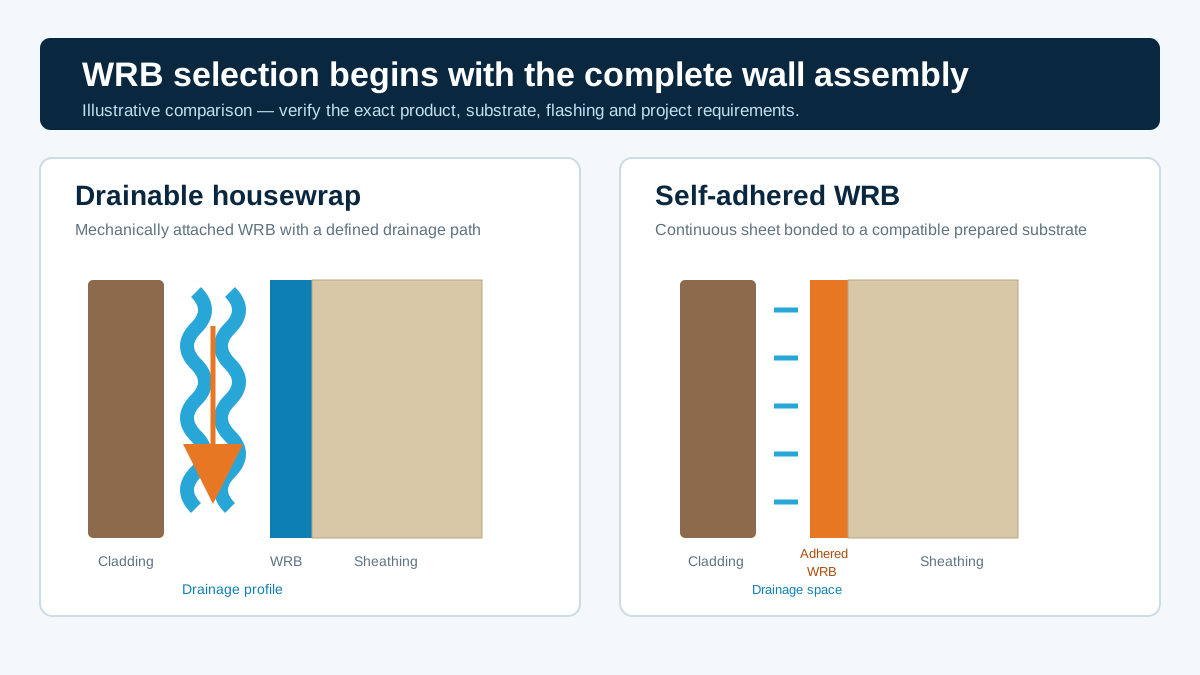
Drainable housewrap is a mechanically attached water-resistive barrier that adds a surface profile or drainage path behind cladding. A self-adhered WRB bonds across the prepared substrate to create a more continuous layer. Neither name proves suitability by itself; the wall assembly, test evidence, transitions and installation conditions still control the decision.
When a drainable housewrap may fit the assembly
A drainable housewrap can be useful where the cladding strategy needs a defined drainage route and the project team wants a lightweight roll that can be mechanically attached. Review drainage direction, fastening, overlaps, window integration, cladding attachment and whether the surface profile remains effective after compression.
When a self-adhered WRB may fit the assembly
A self-adhered WRB can reduce separate fasteners through the field of the sheet and support continuity across compatible sheathing. Confirm substrate preparation, primer requirements, minimum installation temperature, adhesion after exposure, wrinkle control and compatibility with flashings, sealants and transition membranes.
Compare the complete installed system
Do not compare only vapor permeability or a marketing drainage percentage. Build a matrix covering water resistance, vapor transmission, air-barrier intent, substrate, seam method, fasteners, penetrations, UV exposure, repair procedure and installer conditions. Request evidence for the exact product construction and use the approved project details.
Project checks
- Define the drainage and drying strategy before choosing the WRB type.
- Confirm substrate, fastener, tape, flashing and sealant compatibility.
- Match every performance value to its test method and exact product construction.
- Mock up openings, penetrations and transitions before full installation.